Devotionals

RSS Feed

Monkey Medicine (Part 1 of 2) | Creation Moments Minute

Monkey Medicine (Part 1 of 2)

What can man learn about medicine by keeping an eye on monkeys? Find out on today’s Creation Moments Minute.

Folks who are in to natural remedies know that more than a quarter of our drugs come from wild plants. Traditionally, researchers in search of new drugs would ask local folk healers about plants that might be helpful. However, that isn’t always the best approach. In some societies, plants are thought to have healing powers simply because they look like a disease.

Researchers are now learning to follow animals around. Monkeys have led medical researchers to several new medicines. Chimps in Tanzania, for instance, were seen swallowing the unchewed leaves of a tree. Studies of the leaves and the droppings showed that the leaves were not digested. However, the chimps’ digestive system had removed chemicals from the surface of the leaves that kill intestinal parasites.

More about monkey medicine on our next program.

For Creation Moments Minute dot com, I’m Darren Marlar.

Ref: Boyce Rensberger. Researchers: Chimps Use Herbal Medicine.

Identity-Damon Lee

How are we defined? Are we defined by the world, the church, by our experiences and choices? Are these just influences and that there is something more that gives us our identity?

Intelligent Animal Antics | Creation Moments Minute

Intelligent Animal Antics

How intelligent are animals? Can they be taught to understand simple sentences? We’ll answer these questions on today’s Creation Moments Minute.

While debate continues about whether chimps can actually learn to communicate with language, there is little question that they understand simple sentences. However, this doesn’t prove any relationship between man and apes. Research also shows that dolphins and sea lions can learn language.

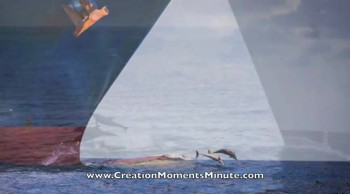
Dolphins also have a few other tricks up their, um, fins. They try to hide from tuna boats by not jumping when a tuna boat is near. If this doesn’t work, dolphins will swim on the right side of the boat because the cranes and nets are usually on the left side.

As one scientist put it, animals are as smart as they need to be, no more and no less. When God made the animals, He was generous with something He has an unlimited amount of – intelligence.

For Creation Moments Minute dot com, I’m Darren Marlar.

Ref: Shannon Brownlee. 1985. “A Riddle Wrapped in a Mystery.” Discover, Oct., pp. 85-93.

The Imperative of Good Teaching

Here is another one especially for ministers. It’s a challenge to actually teach the faith we have been given through the restoration of biblical doctrine and catechisms, which have been broadly abandoned today. The piece also proposes a number of areas of theology, ethics and discipline for churches to teach.

I will put this article up at my holiness and reform website https://www.holinessofthebride.com. The site is an open invitation to join us in reform, and provides many informative resources.

You can read the full text of this piece on pdf here: https://www.holinessofthebride.com/wp-content/uploads/2014/10/Faith-Statement-Restoration.pdf

To support our work towards holiness and reform in the Body of Messiah and in the greater community you can go here: https://www.holinessofthebride.com/donate-2

Lord, please restore the Body of Messiah in godly teaching and lifestyle.

The Rock Climbing Catfish | Creation Moments Minute

The Rock-Climbing Catfish

It's not very pretty, nor is it graceful, but Colombia's rock-climbing catfish has a unique ability among fish. Find out more on today's Creation Moments Minute.

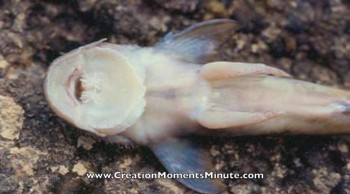
The rock-climbing catfish's climbing equipment begins with a powerful sucker mouth. Once it has attached its sucker to the rock, it pulls up its stomach plate and anchors it. With its body anchored, it moves its sucker up the face of the rock and repeats the process. The fish can walk up a 20-foot rock wall in about 30 minutes!

Who gave the rock-climbing catfish that powerful sucker mouth? Who gave it such a clever bony stomach plate and the powerful muscles to control it? And who taught it to climb rocks? One opinion says that no one did it. The other says that it was the work of God. The Bible's claim of a Creator is the only one that makes sense!

For Creation Moments Minute, I’m Darren Marlar.

Ancient Modern Technology | Creation Moments Minute

Ancient Modern Technology

On today’s Creation Moments Minute, we look at two modern technological marvels that were around before the time of Christ.

It is unfortunate that we so often have the sense that nothing technologically important has happened in human history until modern times. This helps maintain the illusion that humans are indeed progressing and evolving upward.

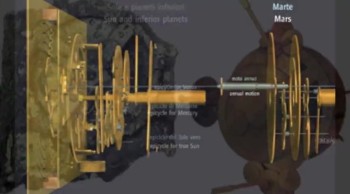
Differential gears, allowing a machine to perform two functions simultaneously, were not used in modern times until 1575. However, a model planetarium using differential gears was found in a ship that sank off Greece in 78 B.C.

That’s not all. While Ben Franklin is given credit for discovering electricity, electric batteries dating from 100 B.C. have been found in Iraq.

Despite all of our modern gadgets, there is no evidence that humans are any more clever today than they were on the first day they walked the Earth – just as the Bible says.

For Creation Moments Minute, I’m Darren Marlar.

God's Chemistry Again Outpaces Man | Creation Moments Minute

God’s Chemistry Again Outpaces Man

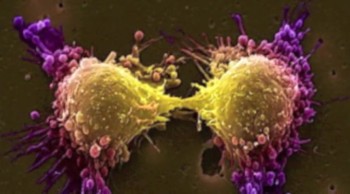
On today’s Creation Moments Minute, we look at how a single fertilized cell divides into many different kinds of cells – including liver cells, skin cells, brain cells, and bone cells.

Human growth factor – a chemical produced by our body – is being studied to see if it is responsible for the development of all those different cells from a single cell. However, this is only one of thirty known chemicals that influence the development of new cells.

Where do all of these incredible chemicals come from? They don't come from laboratories staffed with the best brains in science. They are produced by our bodies. Science should stand in awe at the evident wisdom behind those chemical structures and the way they work. And that's one of the best arguments that we were created by a wise and powerful Creator, not by mindless chemical accidents!

For Creation Moments Minute, I’m Darren Marlar.

Millions of Noses (Part 2 of 2) | Creation Moments Minute

On today’s Creation Moments Minute, we take another look at the lobster’s amazing ability to smell and taste.

Millions of Noses (Part 2 of 2) | Creation Moments Minute

Millions of Noses (Part 2 of 2)

On today’s Creation Moments Minute, we take another look at the lobster’s amazing ability to smell and taste.

On a previous program, we pointed out that lobsters are superior to humans in the ability to smell and taste. In fact, their smell and taste is up to a million times more sensitive than ours. Lobsters actually use their sense of smell and abilities to create various chemicals as a means of communication. Both males and females who are ready to mate use scent signals to communicate their availability. They generate still other scent signals to communicate their readiness to move on to each new step in the courtship.

Those of us who believe that the lobster, like all other creatures, was created by God are not surprised to learn that lobsters show much more complexity than evolutionists ever expected. No living thing our Creator has made is either simple or ill‑equipped for life.

For Creation Moments Minute dot com, I’m Darren Marlar.

Ref: Ravven, Wallace. 1987. "Lobster Lust: Don Juans of the Deep." Discover, Dec., p. 34.

Millions of Noses (Part 1 of 2) | Creation Moments Minute

Millions of Noses (Part 1 of 2)

On today’s Creation Moments Minute, a lobster shows off its ability to smell and taste.

The lobster, with its external shell, is classified as a crustacean and is considered by evolutionists to be among the earlier evolved creatures. But recent study of the habits and abilities of lobsters are showing that these creatures are unexpectedly complex; their abilities are equal to the supposedly more-evolved creatures.

The lobster's sense of smell and taste is up to a million times more sensitive than ours. Scents are picked up by hair‑like tufts on its appendages. When eating, the lobster carefully samples the scent of each item it eats. The lobster never seems to get bored with a long, leisurely sniff of each morsel.

Though many of us love the taste of lobster, when it comes to taste, the lobster is far superior than man – not exactly what evolutionists like to hear!

For Creation Moments Minute dot com, I’m Darren Marlar.

Ref: Ravven, Wallace. 1987. "Lobster Lust: Don Juans of the Deep." Discover, Dec., p. 34.

Intentional Single Woman

"Intentional Woman", Lorri Allen, inspires you in this short video to stay active and healthy.

At the Intentional Living Center we have a passion to help you live for Christ in all areas of their life. Through our ministry you will receive practical, useful help and encouragement, which will help you focus on what matters most and follow through with action to help ignite transformation in your life.

To learn more about the Intentional Living Center visit www.TheIntentionalLife.com

Intentional Healthy Woman

"Intentional Woman", Lorri Allen, inspires you in this short video to stay active and healthy.

At the Intentional Living Center we have a passion to help you live for Christ in all areas of their life. Through our ministry you will receive practical, useful help and encouragement, which will help you focus on what matters most and follow through with action to help ignite transformation in your life.

To learn more about the Intentional Living Center visit www.TheIntentionalLife.com

Feeling Overwhelmed

"Intentional Woman", Lorri Allen, inspires you in this short video to stay active and healthy.

At the Intentional Living Center we have a passion to help you live for Christ in all areas of their life. Through our ministry you will receive practical, useful help and encouragement, which will help you focus on what matters most and follow through with action to help ignite transformation in your life.

To learn more about the Intentional Living Center visit www.TheIntentionalLife.com

A Surprise Platypus (Part 1 of 2) | Creation Moments Minute

A Surprise Platypus (Part 1 of 2)

On today’s Creation Moments Minute, a very weird animal that evolutionists just can’t explain.

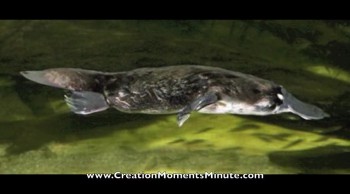
Europe was introduced to Australia's duckbill platypus in 1798. Because of the difficulties of travel in those days, scientists didn't send a live platypus from Australia to the British Museum in London. They sent only a platypus skin. Scientists in London looked at the duck bill, the beaver tail and the webbed feet of this egg laying mammal and immediately denounced the creature as a hoax.

Modern biological research has also shown another mystery about the platypus. (At least it's a mystery for evolutionists.) While the platypus is classified as a mammal, it is genetically as different from all other mammals as mammals are from birds. Nor is the platypus genetically like the bird. This leaves the platypus with absolutely no evolutionary history, almost as if it had simply popped into existence.

More about the amazing platypus next time.

For Creation Moments Minute dot com, I’m Darren Marlar.

Ref: Horton, Elizabeth. 1986. "The electric cool platypus." Science Digest, June, p. 21.

A Surprise Platypus (Part 2 of 2)

A Surprise Platypus (Part 2 of 2)

On today’s Creation Moments Minute we continue looking at the crazy, mixed-up platypus from Australia.

More than two hundred years after scientists in London first started looking at the duckbill platypus from Australia, the creature continues to amaze scientists. Recently researchers discovered a surprising new ability the platypus uses to find food. It seems that the nerves in the platypus's skin, which relay the sense of touch, are also able to sense electricity.

Every time we or any living creature use a muscle, a tiny electric current is generated. When the shrimp that the platypus eats flick their tails, they generate about 200 millionths to 1,000 millionths of a volt of electricity. That small amount of voltage is enough to enable the platypus to sense and locate lunch.

Clearly, the duckbill platypus is one of the most unusual creatures God made on the sixth day of creation week.

For Creation Moments Minute dot com, I’m Darren Marlar.

Ref: Horton, Elizabeth. 1986. "The electric cool platypus." Science Digest, June, p. 21.

The Orchid that Captures Workers | Creation Moments Minute

The Orchid that Captures Workers

On today’s Creation Moments Minute, we look at a relatively rare orchid that behaves almost like an animal at pollination time.

The Coryanthes orchid has a steep-sided flower shaped almost like a bucket. Two glands extend over the center of the "bucket" and secrete a clear fluid into the flower after it opens. When a bee falls into the sticky fluid, it’s impossible for the bee to escape the way he entered. However, the orchid has a tunnel through which the bee can easily escape. But as the bee nears the tunnel's end, the flower drops down a projection from the tunnel's ceiling, holding the bee for about ten minutes before freeing him. While the bee is held, the flower glues two packets of pollen to the bee.

The Coryanthes orchid not only shows us the Creator, but it shows us how unlimited His creativity and imagination are.

For Creation Moments Minute, I’m Darren Marlar.

A Real Sea Dragon (Part 2 of 2) | Creation Moments Minute

A Real Sea Dragon (Part 2 of 2)

On today’s Creation Moments Minute we’ll take another look at a beautiful dragon that roams the sea.

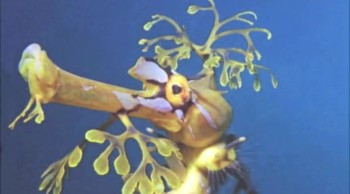
The shapes of sea dragons are the most varied and unusual in the animal world, and their colors are among the brightest. Unlike other fish, they have no scales. They draw tiny marine organisms into their mouths through a trap door jaw that opens and closes more rapidly than the human eye can follow. The eyes of the sea dragon move independently of each other. And when it's time to start a family, it is the father sea dragon who incubates the fertilized eggs in a pouch in his tail.

Like some other creatures we have talked about on Creation Moments, the sea dragon is such a unique creature that evolutionists admit they have no idea how it evolved. These are the very creatures we'd expect to find though, if all things were created by God!

For Creation Moments Minute dot com, I’m Darren Marlar.

Ref: Pennisi, Elizabeth. 1985. "Ghosts and Dragons." Discover, Nov., p. 80.

LASTing Peace Week 50, His Body for Yours

I'm reflecting on Luke 22:19 and the meaning of The Lord's Supper or Communion this week. I saw the meal in a different light as I shared it with the body of Christ at my sister's church.

Reasons Enough for Belief -- 004 The Foundation of Morality

Who is to say what is right and wrong? Where do we get our sense of morality? In this Faith File -- Reasons Enough for Belief I discuss how our desire for fairness, right living, and justice help strengthen the argument for the existence of God. Check out all sever Faith Files in the Reason Enough for Belief series at https://daveclaassen.com/FaithFilesHome.html .

The Gospel as It Relates to Joesph

Joseph's story is more than a flannel-board reminder of how good things come to those who persevere. It's much bigger than that.

First ... 110 111 112 113 114 ... Last

Sponsored Links