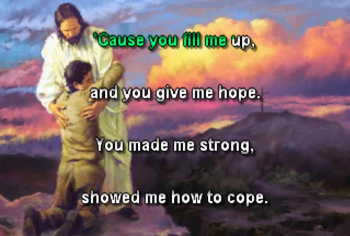
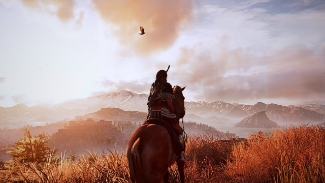
The story of a boy with an invisible friend who becomes mysteriously ill. His parents thought he was silly for believing in invisible beings, and tried to discourage it. That's when the boy fell into a coma, and the song began telling his story.
People often say: if they were the creator of the universe, they'd do things differently than the actual Creator. Naturally, we aren't coming from a Omnipotent, Omniscient, Omnipresent, and Omnificent, perspective. We don’t know how our choices would affect the overall fabric of creation. We say what we say, and believe what we believe, based on a perspective that sees no deeper than the surface. This song attempts to look deeper, in order to understand why God allows us to proudly charge into the outer darkness, where there is weeping and gnashing of teeth. If He were to disregard our choices and force us into heaven, it would violate His “free will” covenant with humanity. Just as we are free to choose our next meal, we are also free to reject God, heaven, and the salvation of Jesus. We go where we chose, in life, to go.
Marilla Ness' version deserves to be a stand alone, not as the third part of my previous video, so I have put it into this version. Revision of the Norwegian text by myself, last night (9-10-25).
Original: Provided to YouTube by The Orchard Enterprises "When I Feel the Touch / Jesus Take Me As I Am" · Marilla Ness; Best Ever Songs of Worship and Adoration ℗ 2012 MLM Records. Released on: 2012-08-01
Contemporary Hymn
Chorus
G D
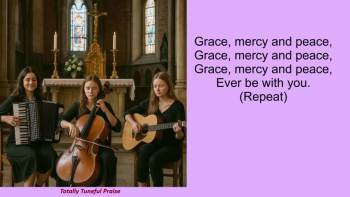
Grace, mercy and peace,
Em Bm
Grace, mercy and peace,
C G
Grace, mercy and peace,
C D
Ever be with you.
G D
Grace, mercy and peace,
Em Bm
Grace, mercy and peace,
C G
Grace, mercy and peace,
C D G
Ever be with you.
Verse
Am D
Grace from God who is our Father,
G C
Grace from God the Son,
Am D
Grace from God who is the Spirit,
G D G
Three in One.
Am D
Grace from God who is our Father,
B7 Em
Grace from God the Son,
C G
Grace from God the Spirit,
C D G
Three in One.
Verse
Mercy from our God who's Father
Mercy from the Son
Mercy from our God the Spirit
Three in One
Mercy from our God the Father
Mercy from the Son
Mercy from the Spirit
Three in One
Verse
Peace be from our God who's Father
Peace be from the Son
Peace be from our God who's Spirit
Three in One
Peace be from our God who's Father
Peace be from the Son
Peace be from the Spirit
Three in One
CCLI Song ID: 7227750
This song was written by Keri Jones and David Matthews, and people have wished they' added more verses. Well, in Norway, they did, so that explains why the texting doesn't always seem to match. I have put together 3 versions of it, and at the end comes Jesus take me as I am, where I have tweaked some of the Norwegian version, but did not actually write the original.
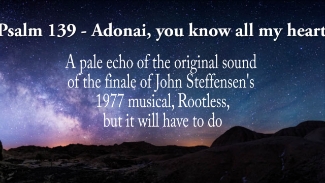
No proper recording of the original choral arrangement seems to have survived, but it made a mighty finale to John Steffensen's second musical.
Melody and Bible-text re-wording: John Steffensen, using the 1978 Norwegian bokmål translation.
Adonai,You know all my heart and fathom me!
Where I sit and when I stand, Aware of it
My mind seen and mapped out beforehand.
Adonai, You know all my heart and fathom me!
If I walk or lay me down, discerning it,
Preserving my coming and my going.
Before the word is on the tongue-tip
Hearing it, everything I say!
Under, over, covering me
You have kept your hand on me.
Under, over, covering me
You have kept your hand on me.
’Tis far too wonderful for the telling.
’Tis far too high For me ever to understand.
Under, over, covering me
You have kept your hand on me
Where can I flee Far from your presence?
Where can I cower from your visage?
If I follow the Milky Way, -You are there! You are there!
If I follow the Milky Way -You are there! You are there!
If my hide-out I make in Hell, —you are there!
Though I try the wings of morning on
And fly away where sky meets ocean
Your Spirit still awaits me there!
The hollow of Your hand Encloses me And if I say:
“Let darkness cover me,The daylight around me be night!”
The dark is as clear as dawn to You!
The dark is as clear as dawn to You!
The night is as clear as morning,
The dark of night, as brightest day.
Ransack me God.
Discern my thinking.
Sift to the heart of my very most soul!
Discover where I Cling to roads of wrong,
And take me the paths everlasting.
The language is deliberately somewhat archaic.
Celtic hymn to the Trinity. CCLI 7261498
D G D A
May the three fold cord entwine you,
D G D A
May the three fold fabric tell,
D G D A
Of the heart that beats to find you,
G A G A D
To restore you and make you well.
C D C D
Cord of the Father, cord of the Son,
C D G A
Cord of the Spirit, Three in One.
May the cord of Father hold,
Draw you gently to his breast.
Not to harm you or to scold you,
But to give you perfect rest.
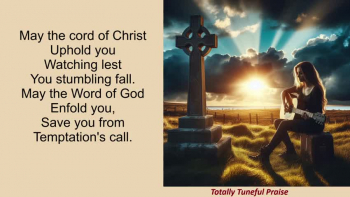
May the cord of Christ uphold you,
Watching lest you stumbling fall.
May the Word of God enfold you,
Save you from temptation's call.
May the cord of Spirit bind you,
Gentle as the cooing dove,
Soothing every hurt behind you,
Till you know that God is love.
Folksie Praise
Chorus
Dm Gm C F
Only one name, only one way,
Bb Gm A
Only one Lord of all.
Dm Gm C F
To whom I pray, to whom I bow,
Bb Gm A
And at whose feet I fall.
Verse
Gm C F Bb
Jesus my King, Jesus my Lord,
Gm C F
Jesus who bled for me.
Gm C F Bb
Worship I bring, praises I sing,
Gm A Dm
Jesus I cry to thee.
Verse
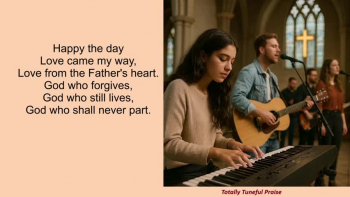
Happy the day love came my way,
Love from the Father’s heart.
God who forgives, God who still lives,
God who will never part.
Verse
Spirit of God, wisdom and love,
Filling me day by day.
Help me to tell this story well,
Give me the words to say.
CCLI Song ID: 7269153
Folksie Praise
Verse
D Gmaj7 D A
Jesus lead me day after day,
D Gmaj7 D A
Show the Father to me I pray.
Bm G
O how could I understand him,
D A
God above all gods.
Bm G
Only when I see your works
D A
And hear your holy word.
Chorus
D Dmaj7
Father Son and Holy Spirit,
Em A
Blessed Trinity.
D Dmaj7
Source of God and face of God
Em A D
And voice of God to me.
Verse
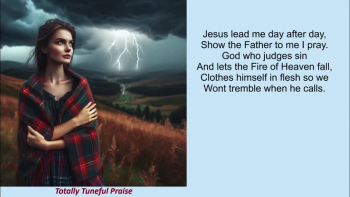
Jesus lead me day after day,
Show the Father to me I pray.
God who judges sin
And lets the fire of heaven fall,
Clothes himself in flesh
So we wont tremble when he calls.
Verse
Jesus lead me day after day,
Show the Father to me I pray.
God is clothed in light too bright
For mortals to behold.
We can touch your hem
And feel your power fill our souls.
CCLI Song ID: 7260963
How our Death Row became our Victory Row! "The sign in which we conquer"
By a sheer oversight, this video was missed out of my uploads of this Croatian song that won the Split Easter Festival prize in 2003. Enjoy your victory!
Lyric video of the title song “A New Kind of Warrior” from the multiethnic Heart of the City Band CD “A New Kind of Warrior” (c) 2025 Heart of the City Music. Words and music by Dan Adler. Performed by Heart of the City Band. Lead vocals by Todd “Papa Bear” Finney. Scripture from Ephesians 6:12-17 of the Holy Bible (NIV). Available to order or download www.danandsandyadler.com or at iTunes or most MP3 sites. Charts and background tracks available at praisecharts.com.
Credits:
Video created by Danielle Super
O My Soul is a devotional for the weary and the grateful alike, reminding us that healing, forgiveness, and redemption are present gifts. Remember who God is and what He's already done for you.
Salem Media, our partners, and affiliates use cookies and similar technologies to enhance your browsing experience, analyze site traffic, personalize site content, and deliver relevant video recommendations. By using this website and continuing to navigate, you consent to our use of such technologies and the sharing of video viewing activity with third-party partners in accordance with the Video Privacy Protection Act and other privacy laws.Privacy Policy